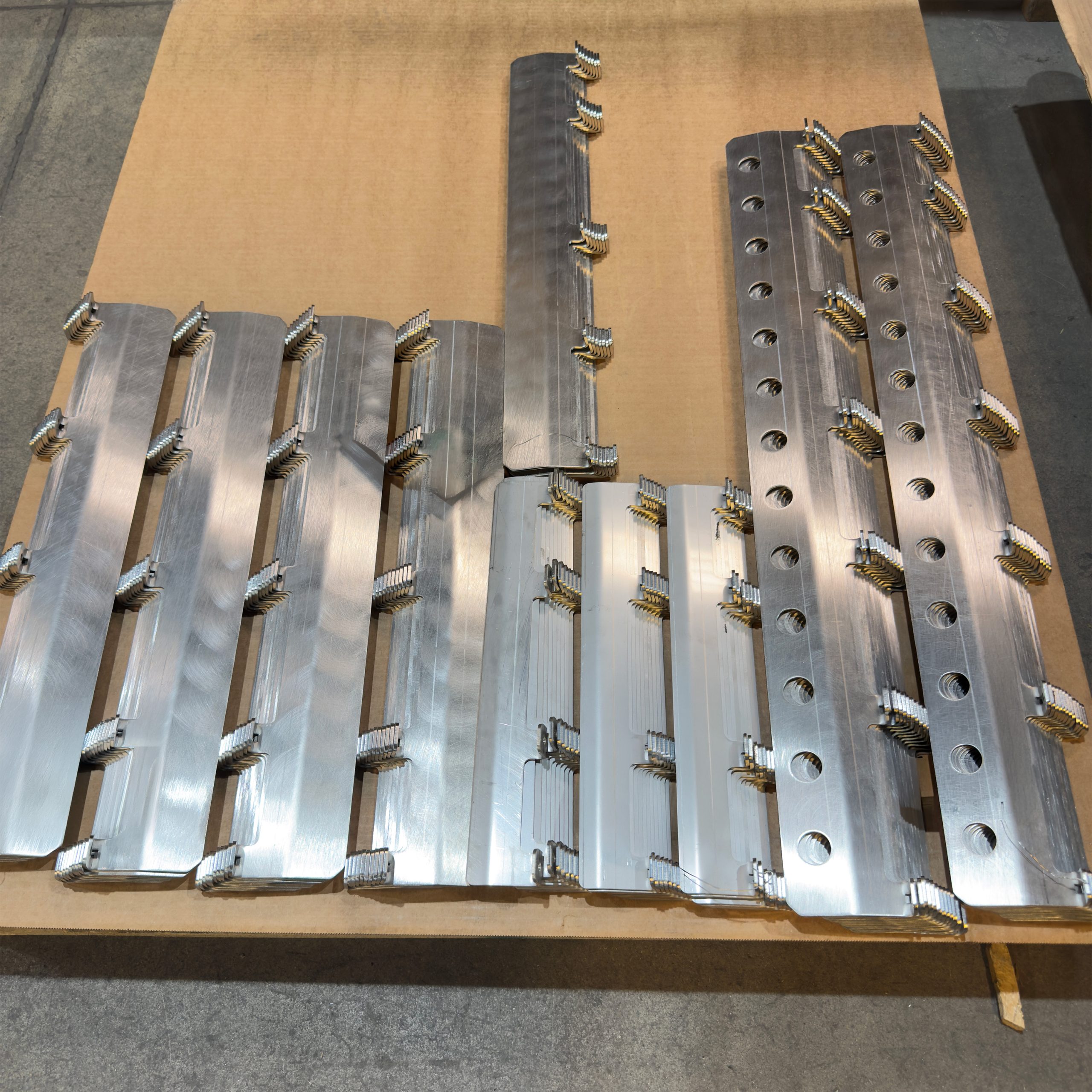
At York Haven Fabricators, aluminum fabrication is one of our core specialties. From lightweight structural components for our partners in transportation and infrastructure, to metal enclosures, to panels, hardware, and other precision components throughout the energy sector, demand for aluminum parts has never been higher.
Compared to steel fabrication, working with aluminum demands some different process considerations. We wanted to create an overview of what that looks like here at YHFAB.
Understanding and Working with Aluminum Materials
Aluminum is obviously not a single, uniform material. It’s a huge family of alloys, each with its own mechanical properties, formability, and finishing behavior.
- 5000-series alloys like 5052 are generally used for their corrosion resistance and workability, great for metal enclosures and various components in outdoor equipment, from automotive and transportation to marine and boating products.
- 6000-series alloys like 6061 are extremely common across industries and applications, offering a great combination of lightweight strength, corrosion resistance, and cost efficiency. We make everything from basic structural brackets to specialized high-precision machined components out of 6000-series aluminum grades.
And that’s just scratching the surface of the common alloys. Working with so many different alloy types is where manufacturing experience becomes a huge factor. Not only does aluminum behave differently than steel under heat, pressure, and tool working, but so do different types of alloys and aluminum grades.
Basically, we work to optimize every step of fabrication, from cutting to forming to rolling, dialing in our tooling and processes specifically for the alloy and temper being used.
Quick Reference: Aluminum Considerations by Process
These are just a few of the variables our team accounts for on every aluminum job. Check our full range of services on our Capabilities page.
| Process | Key Consideration | Why It Matters |
| Laser Cutting | Reflectivity and thermal conductivity | Aluminum reflects laser energy and dissipates heat quickly, requiring tuned power and speed settings |
| CNC Forming | Springback and grain direction | Aluminum springs back more than steel after bending, so tooling and bend allowances must be adjusted |
| Turret Punching | Work hardening and burr control | Aluminum can gall or burr differently than steel, requiring proper tooling clearance and lubrication |
| Plate Rolling | Ductility limits and section thickness | Aluminum has less ductility than mild steel at comparable gauges, affecting achievable radii |
Laser Cutting Aluminum Parts
Laser cutting aluminum requires more than just swapping settings from a steel program. Aluminum’s high reflectivity and thermal conductivity mean our fiber laser systems need precise power, speed, and assist gas adjustments to achieve clean edges without excess heat-affected zones or dross.
Our team has refined our unique laser cutting processes and parameters across a wide range of thicknesses and alloys, so parts come off the table ready for the next operation with minimal rework.
At YHFAB, we take on a wide range of laser cutting aluminum laser-cut products include:
- Electronic and equipment enclosure panels
- Structural brackets and mounting plates
- Perforated panels for ventilation or lighting fixtures
- Custom machine guards and access panels
- Base plates for automation equipment
CNC Forming Aluminum Materials
Forming aluminum on our multi-axis CNC press brakes calls for some special considerations compared to forming steel. Most notably, aluminum tends to spring back more after bending. Our programmers calculate bend allowances and tooling selections specific to each alloy and temper to hit tight tolerances consistently. Grain direction also matters here, since bending against the grain on certain alloys can lead to cracking if it is not accounted for upfront.
With robotic bending and CNC forming integrated seamlessly into our process, we can produce complex, multi-bend parts with the repeatability that our customers rely on to be accurate, run after run.
Here are some of our typical CNC-formed aluminum products:
- Chassis and frame components for automotive applications
- Enclosure housings with multiple formed flanges
- Lighting fixture bodies and reflectors
- Ductwork and transition components
- Brackets requiring precise angles and hole alignment
Turret Punching Aluminum Sheet and Plate up to .250 inches
Turret punching is a fast, cost-effective way to create hole patterns, louvers, and flat-part blanks, and aluminum brings its own set of considerations to this process. Because aluminum can be softer and gummier than steel, tooling clearance, lubrication, and stripping force all need to be dialed in to avoid burring or material pickup on the punch.
Our CNC turret systems are set up to handle aluminum sheet and plate up to .250 inches thick, giving us the flexibility to punch everything from delicate ventilation patterns to heavier structural blanks.
A few of our common turret-punched aluminum products include:
- Ventilated equipment panels and covers
- Perforated screens and filter frames
- Flat blanks for downstream forming operations
- Access panels with standardized hole patterns
- Nameplates and identification panels
Aluminum Plate Rolling
Rolling aluminum plate into cylindrical or curved shapes takes a careful touch. Aluminum has less ductility than mild steel at comparable thicknesses, so we account for material spring-back, minimum bend radii, and roll pressure to avoid cracking or surface marring during the process.
Our in-house plate rolling capability lets us produce curved structural components that hold their shape and dimensional accuracy through welding and finishing.
Some of our typical rolled aluminum products include:
- Cylindrical tanks and pressure vessel shells
- Curved structural supports and columns
- Ductwork transitions and tubular housings
- Rolled shells for lighting and enclosure assemblies
- Architectural and decorative curved panels
Experienced Aluminum Fabrication – Quality American Manufacturing
Aluminum fabrication rewards experience. The alloy that performs beautifully in one process can behave unpredictably in another if the settings, tooling, or handling are not matched to its properties.
At YHFAB, our engineering team factors these material-specific variables into every project from the earliest design conversations through final inspection, so the parts that leave our facility perform exactly as intended, whether they are headed for a transportation OEM, an energy sector application, or an automation line down the street.